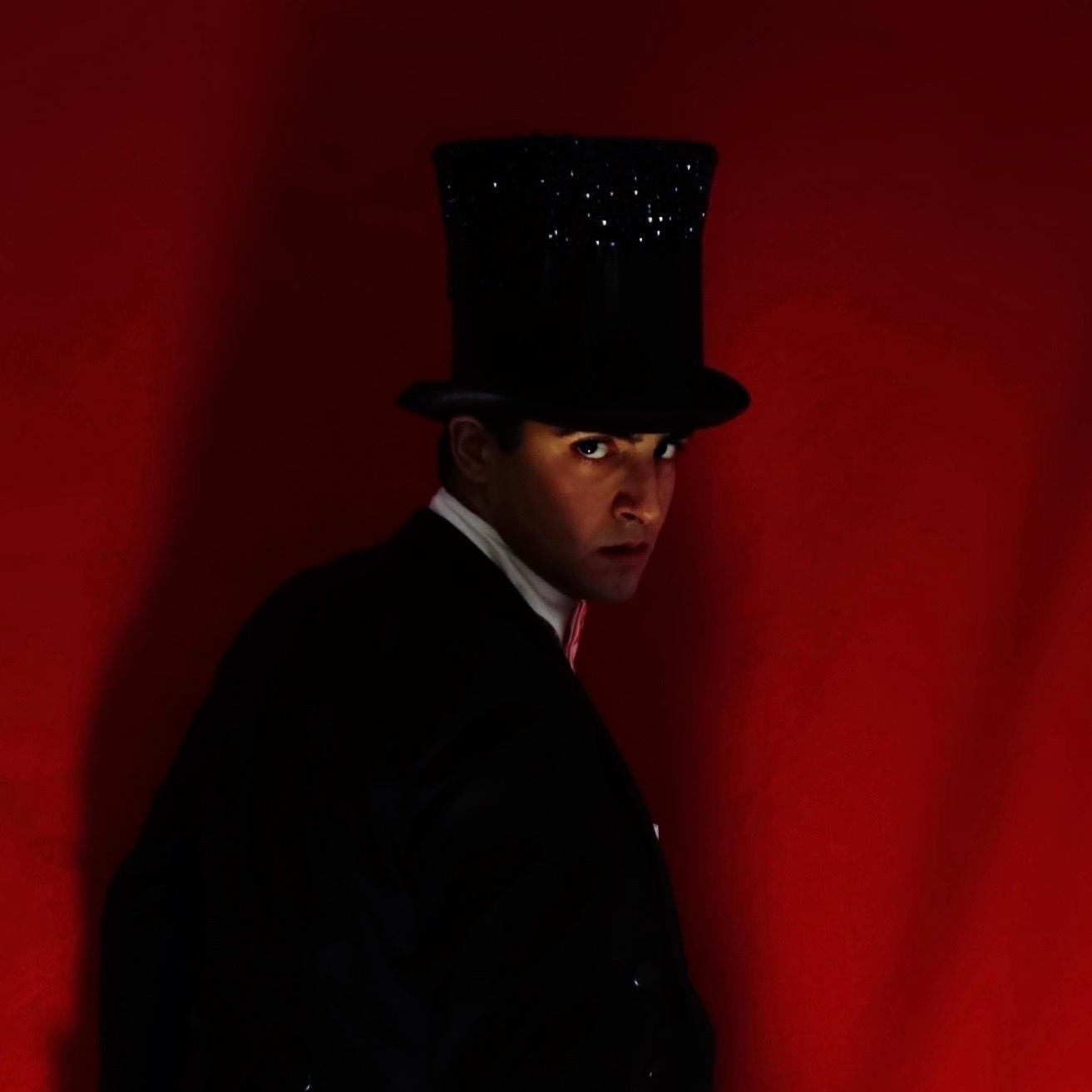
In an extensive interview with baynspace Egyptian-Palestinian artist Samo Shalaby discusses his practice vis-à-vis its inherent theatricality and symbolism amongst his love for the antiquities.
You come from a creative family. Your mother and aunt are both artists, and your sister is creative too. Did you always want to pursue the arts?
SS: I honestly do not think I ever doubted that this was my path. Maybe I’m biased because I grew up surrounded by artists, but there was never a version of my life where art was not part of it.
My mother is a bespoke painter and muralist, my aunt is a spiritual and political painter, and my sister lives and breathes design (homeware, fashion, interiors). Creativity was not just encouraged, it was normal. It was the air, something I am grateful for every day. It felt less like a decision and more like a language I already spoke. Of course, I have been tempted by other extensions of it. Such as fashion design, jewellery, history, antiquities, and interiors. But they never felt separate from painting. They felt like branches of the same tree. Everything feeds everything. Even when I drift, I am still orbiting the same star. I know it sounds cheesy, but art is not something I chose. In a way, it chose me. It’s the lens I have never taken off.

You studied at Central Saint Martins in London. How was your time at university in the UK?
SS: London itself was transformative. I lost and found myself there in so many ways. Living alone, being in that city, being exposed to so much, that part was invaluable. But if I am being honest, educationally, I was disappointed. I went in thinking I would be challenged technically and intellectually, that I would learn academic rigour, art history in depth, and real craft. Instead, I felt like I was constantly being placed into a box. As an Arab artist, there was this unspoken expectation that I should create from a very stereotypical, almost orientalist perspective. I was once genuinely asked why I did not paint pyramids in the background of my work. That moment stayed with me. It felt less like individual voices were being nurtured and more like we were being flattened into something palatable. Theory was ‘taught’, but it often felt like being spoken at rather than guided. In terms of technical skills, you were expected to figure that out alone. The real education I received was outside the classroom. In libraries, in museums, assisting other artists, apprenticing, actually doing the work. Doing, not dwelling. I have always believed that intuition and impulse carry a kind of intelligence that can’t be over-academised. Sometimes you just have to make the thing and let it teach you. Art, for me, has always been sacred. It started as something deeply personal, an outlet, a necessity, a form of self-expression. In my younger years, simply just being creative, moving my hands as my mind follows, and vice versa. Now that it’s also my profession, I’m very protective of that core. I do not believe art should be made to satisfy Western institutions or seek external validation. It has to be honest first. I think sometimes, especially as artists who become professionalised, we need to remember why we started. It was not for applause. It was because we had an urgency to make, a calling.

You work across a variety of disciplines including painting, photography, stage and costume design, and jewellery, but are perhaps best known for your dramatic and meticulous paintings. As a fellow Gemini I wonder if your multifaceted interests are related to your Zodiac sign or more of a personality trait?
SS: To be very honest, coming from a family of mostly Geminis, and not knowing that much about astrology, I am probably the least Gemini of them all. They are spontaneous, restless, wired. I am actually quite the opposite. I am calm, very much in my own world, fairly quiet until I know exactly how to articulate what I’m feeling. I am less impulsive and more of a planner. And I think that translates directly into my work. That said… I am a Gemini. So I will not deny that duality exists within me. Painting is my anchor. Whatever I am feeling, whether that be overwhelmed, sad, ecstatic, I paint. It is the spine of everything I do. But I have never experienced creativity in a single lane. When I am thinking about a painting, I am also thinking about the costume that the figure would wear, what that costume says psychologically, the set they stand in, and the objects they carry. It is less about being ‘multifaceted’ and more about wanting the world of the work to feel whole. Complete. Intentional. The work may be visually rich, but it is never decorative for decoration’s sake.
I do not see disciplines as separate practices. They are just different doors into the same room.

Yet the inherent theatricality within your practice unites all these diverse fields. I have always found your work so fascinating because the theatricality seems to come about so naturally and effortlessly, although due to your technique and attention to details the works require a lot. To what extent is the theatricality a conscious choice?
SS: It’s both instinctual and deliberate. I do not sit down thinking, ‘Let me make this theatrical’. I think I just naturally experience emotions in a heightened way. Visually, symbolically, or atmospherically. I grew up around storytelling, around myth, around big gestures. That language feels native to me.
My sketches are chaotic. They are almost like visual vomit straight from the brain onto paper, very raw and immediate. But the execution in paint is extremely controlled. The composition, the lighting, the drapery, the position of a hand, the colour theory, and even its historical symbolism, all of that is meticulously considered. My paintings are heavily pre-planned.
That control does not make them less authentic. If anything, it allows me to communicate more precisely, and yes, it can be exhausting and time-consuming. But in a slightly sadistic way, I enjoy that intensity. Nothing compares to that final, single-haired brushstroke landing exactly where it needs to.
Of course, not everything survives the process. Sometimes what I planned does not feel right once it is on canvas, and I allow myself to adapt. But I like having intention. I like having a framework. Theatricality, for me, is a way of amplifying something internal so it becomes visible. It is truth told through fiction, revealing itself the more you sit with it.

But given this theatricality, I have to ask you, Samo, are you a dramatic person? What do you reckon are the bases of the dramatic qualities in your work?
SS: If you only know me through my work or social media, you might imagine I am this wild, untamed, overly dramatic being. But it is actually quite the opposite. In daily life, I am very calm. I like quiet. I need solitude to think clearly and to centre myself before I create. I am sensitive to energy, so I recharge often, usually alone. I am happiest in very simple moments. The drama in my work does not come from chaos. It comes from contrast. I am fascinated by tension and dichotomies. Beauty and decay, devotion and ego, light and shadow. That friction creates the theatricality. It is less about exaggeration and more about amplification. Internally, everything feels cinematic. In my paintings, that becomes overtly theatrical. But outwardly, I am the guy in a Bauhaus T-shirt and black bug-eye sunglasses, sitting alone at a small café eating a tuna melt, completely content. I have definitely had years where I was more outwardly dramatic, more expressive, more performative. I think I needed that phase to discover who I actually was. It is definitely an ongoing process. But internally, I have always been quite steady. So maybe the work performs what I do not.
In my view the theatricality goes very well with the number of dichotomies present in your work–beauty v. darkness; exhibitionism v. mystery for example. How do you approach your work thematically?
SS: I like this question. Believe it or not, I often start with titles. I have this ongoing list in my notes where I collect random words or unexpected pairings that feel charged somehow. Sometimes a title alone will trigger an entire visual world. It becomes a seed. Other times, it begins with sketching very loosely. Or from a song, an album, a fashion show, a book I have read, or even a museum visit. Inspiration does not come from one fixed source. But what is consistent is that I rarely make one-off works. I tend to build in series. I like constructing a contained world, not the whole universe, but enough of a glimpse that you can feel it and almost taste and smell it. I want the viewer to sense atmosphere, texture, and even temperature, even though it is just a collection of 2D flat surfaces. Research is also a big part of it. I have been collecting archival books for years, and I am constantly discovering fragments, images, historical references, and symbolism that spark new directions while I am in the studio. As for the dichotomies, they are not constructed for intellectual effect. They are just how I experience life. The older I get, the more I realise very little is black and white. Adulthood is about standing in the grey. Standing in those murky waters, observing both the sun and the moon simultaneously. Beauty is always shadowed by fragility. Exhibitionism often conceals vulnerability. I think my work is an ongoing attempt to reconcile opposites in the same framework, embracing balance in tensions.

You are also well-known for your work’s intensity and layeredness. To what extent the richness in symbolism is an intentional storytelling device?
SS: Symbolism is essentially the language I speak. Every object I place carries weight. It says something about the character, the psychological state, the period the painting inhabits, or the world surrounding it. Even the colours I choose are intentional, I am very aware of their historical meanings and associations within colour theory and art history. Sometimes it is obvious, sometimes it’s more of an ‘if you know, you know’ moment. I like that balance. I do not want to explain everything outright. I want viewers to discover things over time. One of my favourite things is when someone approaches me with an interpretation I had not consciously considered. It does not dilute the meaning, it expands it. Symbolism should invite dialogue, not close it. There is also a literal layeredness to the paintings. I work primarily in acrylic because it allows me to build rapidly. Dozens, sometimes hundreds, of thin layers in a single day. Oil would slow that rhythm in a way that does not suit how I think or work. Even though the surfaces appear flat and controlled, they are built up gradually. I varnish in stages, and sometimes I paint between varnish layers to create depth. Almost like a 19th-century diorama effect. The layering is conceptual as much as it is physical. I build layers because that’s how memory works. Nothing in life is flat.

Many of your works, for example The Masquerade and Fantôme Fête almost read as performances. As much as they are breathtaking paintings they are also examples of complicated, multilayered scenes. How do you approach scene setting as a painter?
SS: Those works belong to my “Figurative Theatre” series, which I began in 2019. It’s an ongoing body of work I am deeply committed to. I have ten paintings sketched and planned, with frames ive designed myself included. So far, I have completed three. The fourth has been living in my sketchbooks for years, waiting for the right moment. Scene setting is the foundation of that series, quite literally setting a stage. Before I paint anything, I construct the world. I treat it almost like directing a film or designing a theatrical production. Every character has a role, a purpose, and a costume. Psychology and body language are intentional positions within the narrative. I design the set, the lighting, and the atmosphere. I think about what happened five minutes before this moment and what will unfold five minutes after. The planning phase is immense. Sketchbooks filled with character studies, costume drafts, and architectural layouts, notes on each character, and the overall story. In The Masquerade, for example, I wanted something almost Alma-Tadema-esque, referencing one of my favorite works of his, The Roses of Heliogabalus. That marble grandeur, that lush suffocation of roses, but with something subtly ominous beneath it. There is beauty, but there is tension. Something is about to rupture. That balance between opulence and unrest is very intentional, and where I like this series to thrive. These scenes exist somewhere in between worlds. Not entirely ours, but not entirely fictional either. I am always drawn to that threshold space. I want people to feel that every time they come back to it, they see something new. This series is probably the most complete synthesis of all my interests. Painting, set design, costume, storytelling, architecture, antiquity, symbolism, and personal narrative. It’s where everything converges. If there is a body of work that feels closest to how I see myself as an artist, it is this one.

The same elements of scenes and theatre are present in the “Curtain Call” series. Could you tell us more about these seven works which all seem to conceal and reveal as they embody a mysterious moment in your characters’ lives.
SS: The “Curtain Call” series feels like a microcosm of the larger Figurative Theatre body of work. I began it when I moved back to the Arab world after leaving London. At that time, I was navigating how to express myself in a way that did not feel filtered or diluted. Eventually, I realised I could use that tension to my advantage. That is when I learned how to scream in whispers. The series debuted in my show titled What Lies Beneath, which speaks directly to the premise: what lies behind the curtain, but also what lies beneath the symbolism, beneath the surface, beneath what is immediately visible.
In these works, the curtain or veil becomes a psychological barrier. A space between reality and fiction, concealment and revelation. The figures are suspended in that threshold moment, the inhale before something is spoken aloud.
Colour plays a major role. Each painting revolves around jewel tones. Emerald and ruby, tanzanite and citrine, amber and azurite, and those choices are never arbitrary. They carry historical and emotional associations. The final works in the series subtly reference Earth’s elements. Water, fire, and air.
The subjects touch on love, loss, spirituality, the occult, desire, and even politics. But they are layered in a way that invites contemplation rather than confrontation. I did not feel the need to scream. I could whisper, and trust that those meant to hear it would. What I enjoyed most about this series is that it requires the viewer to read between the lines. Some might see just a beautiful painting. Others will sense the undercurrent. I am comfortable with that. Not everything needs to reveal itself at once.

Does it ever exhaust you to create such emotionally intense paintings? What do you do when you are not painting?
SS: Yes, completely. Every time. But it is always worth it. Creating these works is emotionally and physically demanding. I pour everything into them. When I finish a large painting, I often feel emptied out for a few days, but also strangely whole. It is a paradox. Finishing a painting almost feels like a small funeral. You have lived inside that world for months, sometimes longer, and suddenly it is resolved. It is no longer yours in the same way. Starting a new one feels more like a birth, uncertain, fragile, full of potential. Each work has its own life cycle.
I am not the best multitasker. When I am deep in a painting, that is all I hear. The rest of the world goes quiet. It is not neglect, it is immersion. When I am not painting, there is usually a slow volcano building inside me, a kind of creative call that reminds me I need to return to the studio. When I step away, I tend to be quite ordinary. I like small, quiet moments. I spend time with friends and family. I read. I research. I travel when I can, especially to antique markets and museums. I enjoy park days, long walks on interesting streets in beautiful cities, and finding little alleys and niche boutiques to pique my curiosity. But painting is my equilibrium. It is my comfort and my challenge at the same time. It is where everything settles.
Although many of paintings are opulent in the sense that there is a lot to look at and even more to take in you still, in my view, beautifully express a variety of complicated emotions at the crossroads of identity-related questions and more fundamental human emotions such as love and longing. Do you ever feel that the aesthetic and symbolic qualities in your work override the thematic ones?
SS: Actually, I see the aesthetic and symbolic richness as the entry point. Beauty is disarming. It invites you closer. The technique, the color, the opulence — those are what draw the viewer in. But once they step closer, they start to notice the tension underneath. The darker undertones. The psychological layers. If someone initially thinks, ‘Oh, this is just a beautiful painting’, that’s fine. That is the first door. But the longer they look, the more complicated it becomes. So no, I do not feel that aesthetics override the theme. I think they carry it. The surface seduces, but the emotion lingers. If anything, I use beauty intentionally. Not to distract, but to hold space for difficult or layered conversations. Sometimes people are more willing to confront something heavy if it’s wrapped in something beautiful. For me, aesthetics and theme aren’t competing forces. They’re inseparable. One supports the other.

Which series is the most personal to you? My guess would be Genesis & Ecdysis. Could you tell us more about these works?
SS: I have several bodies of work that feel deeply personal for different reasons. Figurative Theatre was personal because it marked a return to painting after a three-year period where I did not paint at all. I did not realise how empty I had felt until I picked up the brush again. That series felt like a kind of salvation. But if I had to choose now, I would say Ecdysis and Genesis. They’re quieter than Figurative Theatre. There is no elaborate stage, no crowd of characters. Just two self-portraits. A diptych. Simple, direct, almost confrontational in their stillness. They were painted during a moment in my life when I genuinely felt I didn’t recognise myself anymore. Not in a tragic way, but in a transformative one. There was a mourning for who I had been, and at the same time an acceptance that something new was emerging. I had to let a former version of myself dissolve in order to step forward.
The diptych meditates on cyclical forces. Destruction and creation, departure and arrival. Ecdysis marks the act of shedding and transformation. Genesis captures emergence, the almost violent beauty of becoming. Even the pigments were chosen intentionally. Ecdysis was painted using only four colors, inspired by the Magnum Opus of alchemy and Carl Jung’s idea of inner transformation, each pigment reflecting a stage of alchemical evolution. Genesis, on the other hand, is grounded in the earth. The void was painted with Redstone, a red ochre pigment made from iron-rich clay used in prehistoric cave art. In the Book of Genesis, the first humans were formed from clay. I wanted that material connection to earth, body, and blood. What separates this diptych from Figurative Theater is that these works are not performances. They are confessions.

As you know, on a personal level I am obsessed with your Memento Mori Collection. As a fellow collector (and hoarder, hehe), there’s something deeply moving about bringing antique objects back to life by hand painting them.
SS: The Memento Mori Collection actually began by accident. When I was living in London, I was constantly at markets, collecting antique jewellery, frames, and small forgotten objects from the Art Nouveau, Victorian, Edwardian, and Art Deco periods. I was, and still am, completely obsessed with those eras. I knew everything about them. I was a total geek.
One day, I bought an empty Art Nouveau frame. It was beautiful but hollow. I remember thinking, this needs a face. So I painted one, and something clicked. After that, I kept searching for more pieces. Lockets, brooches, frames, and finding incredible treasures at markets. I started painting into them, wearing them, carrying them. And slowly, it became a body of work. I have made hundreds since. There is something deeply moving about giving new life to an object that has already lived one. In a way, it became a quiet form of sustainability, not creating something entirely new, but extending the life and meaning of something forgotten.
The collection also draws from historical traditions like Victorian mourning jewellery and Lover’s Eye miniatures, which I have always been fascinated by. Those original pieces are rare and often inaccessible, so I began creating my own contemporary homage. They nod to the past, but they speak to present relationships. Lovers, parents, friends, capturing intimacy in fragments. Compared to my larger paintings, these works are quieter. More intimate. Less theatrical. But just as personal. There’s something sacred about holding an object that has already carried memory. When I paint onto those objects, I’m not overwriting history. I’m conversing with it. A soft resurrection.

At your studio in Dubai I discovered that you really have an eye for all kinds of fascinating objects and memorabilia from the past, including the incredible scrapbook collection you have. What are some of your most treasured finds?
SS: My studio may be small, but when you open the door, it is a cabinet of curiosities. Every surface carries something with a past. Some of my most treasured finds are two Victorian scrapbooks, dated 1871 and 1880. They are extraordinary because they are deeply personal archives. Someone carefully cut each image by hand, arranged them, pressed them into pages, constructing a visual diary of their time. You can feel the care in every page. They are not just objects; they are preserved intentions. I also have a two globe de mariée (ornate wedding domes) that traditionally held a bridal crown, mirrors, and symbolic objects. The mirrors would sometimes multiply over time, representing children and the life built within the marriage. I am fascinated by how symbolic and ritualistic these objects were, how they carried private narratives within decorative form. So romantic. There are these huge oversized 1920s optician display spectacles that once hung in a shopfront. A chatelaine perfume bottle shaped like a sword, dated back to the 18th century. Mourning jewelry. Handwritten letters sealed in boxes. Strands of calligraphy that feel almost alive in their intimacy. I collect instinctively, but not for monetary value. I am drawn to emotional residue, to the historical charge each object carries. I like holding something that has already witnessed another life, even though I am careful when I collect, as some objects can harbour unwanted energies in your space, and others feel very welcome. They feel like fragments of frozen time. Mementos of the past, steady in the present.

What are you working on right now?
SS: Right now I am working on a painting on pure aluminium for a show in Venice titled Fragrance of Memory. The premise was to challenge figurative artists to work without the figure, to evoke scent through objects and atmosphere. I knew immediately I did not want to take the obvious route of florals or Dutch-master-style still lifes. That did not feel honest to me. As usual, I started with a title: The First Frost. I wanted the work to ‘smell’ like ice, metal, and hair, something cold and intimate rather than sweet. That led me to the chatelaine, the 19th-century utility belt worn by women, carrying keys, scissors, scent bottles, objects that quietly revealed who they were and how they lived. I began thinking of it as a portrait of a woman without her being physically present. Materially, it is a departure for me. I am working directly on aluminium and incorporating marble dust, diamond dust, and frost-like crystalline textures. The surface itself has to feel cold. Reflective. Almost inhospitable. I am currently deep in the metalwork and detailing — designing the chatelaine itself, building its structure, letting it float in a kind of suspended winter silence. It is still evolving, but it feels like a new threshold for me.
Any wishes for 2026?
SS: For 2026, I want to feel more grounded. More present with myself and my process. I would like to create without constantly thinking about the external world or the art world, to return in some ways, to making work purely because I need to. I already feel that shift beginning this year. What I am working on now feels like the right first step, the right door to open. I want to keep evolving without losing the core of why I started. To protect what’s sacred in my practice. Beyond work, I want to slow down just enough to truly experience each chapter as it unfolds, to travel and discover more, to appreciate the people I love, and not to take moments for granted. Growth is important. But so is presence.

What are you currently reading?
SS: I just finished The Silent Patient, which was a great psychological twist involving an artist couple and a psychiatrist. I’m currently reading The Alchemy of Blackbird, a historical fiction novel tracing painter Remedios Varo’s escape from France to Mexico, crossing paths with Leonora Carrington and Max Ernst along the way. I’m also re-reading Sharp Objects after years, the unsettling buildup is just too good.
What’s playing on your headphones?
SS: Right now this is what has been on my rotation:
1: Riders on the Storm — The Doors
2: Give Me a Flower — Laid Back
3: Curtains — Elton John
4: White Feather Hawk Tail Deer Hunter — Lana Del Rey
5: How Does It Make You Feel? — Air
6: Cars — Gary Numan
7: Thinking of a Place (Live) — The War on Drugs
8: Has to Be — Madonna
9: Just Like Heaven — The Cure
10: Better Days — Graham Nash
Who inspires you the most?
SS: Artists who are unapologetically themselves, especially across disciplines. Alphonse Mucha and the ambition of The Slav Epic. The paintings of Mohamed Sami. The Countess of Castiglione and her radical self-portrait photography in the 1860s. Thierry Mugler and his monumental 90s fashion spectacles. David Bowie and his constant reinvention in the 70s. The stage designs by Romeo Castellucci. I’m inspired by people who commit fully to their vision, even when it feels excessive.
If you had to live in another era where and when would you exist?
SS: Between the 1890s and 1910s. Drifting between Paris, London, and Vienna. The height of Art Nouveau. Symbolist painting. Velvet interiors and intellectual salons. Trotting from the House of Worth to the Palais Garnier for a masked ball, then off to wander through the Exposition Universelle of 1900.
Surprise dinner guests are arriving in 1h. How will you prepare?
SS: Ideally? Candles everywhere. Low, atmospheric lighting. Incense burning. Velvet throws and feather-down pillows, A vinyl record playing, and of course, otoro sashimi drenched in ponzu, laid out dramatically across lace-draped tables with delphiniums in bloom.

See Samo Shalaby’s website here and follow him on Instagram here.
See also his limited edition prints currently available at Qaf Editions.